
Native lipid bilayer display for true membrane protein conformation
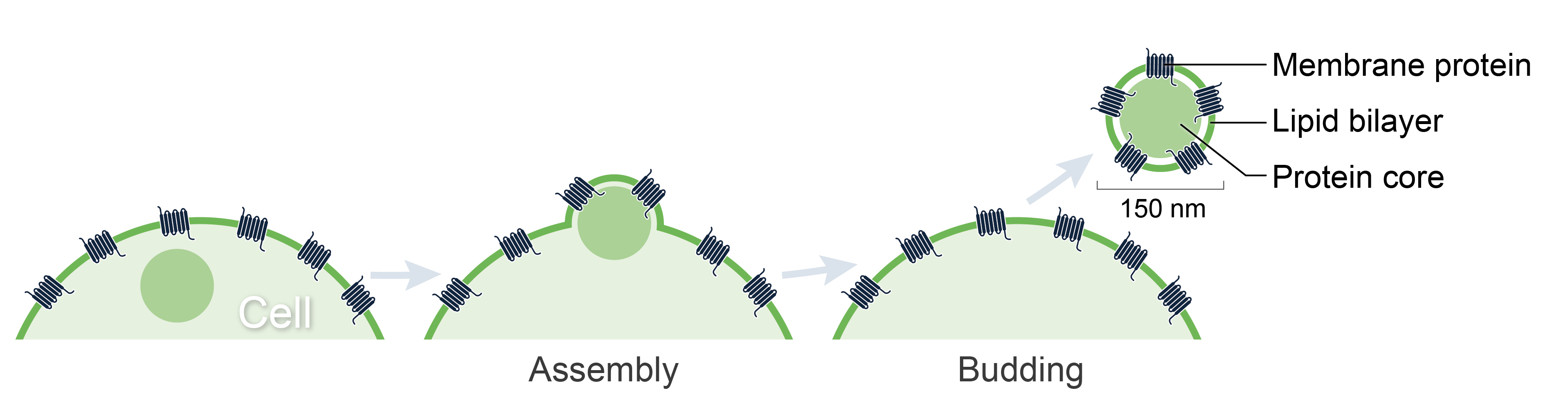
Virus-like particles (VLPs) are self-assembling nanoparticles derived from non-infectious viral structural proteins. When engineered to express a membrane protein of interest, they bud from mammalian cells carrying the protein embedded in a native lipid bilayer, preserving the full-length structure, correct topology, and extracellular domain orientation that other formats cannot replicate.
Built on the Lipoparticle technology pioneered by our parent company, Integral Molecular, Cell Surface Bio (CSB) VLPs bring 25 years of membrane protein expertise directly into your workflow. CSB VLPs present concentrated, full-length, conformationally intact membrane proteins in their native lipid environment. Our ready-to-order VLPs are purpose-built for presenting the most challenging proteins, including GPCRs, ion channels, transporters, and tight junction proteins. They are ideal for antibody discovery and assay development, with preserved native topology, post-translational modification, and extracellular epitopes making them uniquely suited to the toughest membrane protein targets that have historically been the hardest to drug.
The CSB VLP Advantage
Built on the Lipoparticle technology invented by our parent company, Integral Molecular. CSB VLPs bring 25 years of membrane protein expertise directly into your workflow. Our catalog is the industry’s largest, containing the depth, quality controls, and supply chain reliability your research depends on. We don't just say our VLPs are high quality; we show it on every batch with the QC metrics used to characterize each lot for sale.

From the original creators of Lipoparticle technology
25+ years engineering full-length membrane proteins in their native conformation

Extensive validated VLP catalog
The largest, most well-characterized VLP catalog in the industry

Quality proven on every lot
Every lot is released against defined specifications for target incorporation, particle size, and monodispersity.

Manufactured in-house
Produced in-house at our Philadelphia, PA (USA) facility for dependable lead times and supply continuity.
VLP applications
Because VLPs display full-length target proteins in their native conformation in a soluble format, and at high concentration, they can be used for a broad range of applications.

Antibody Generation & Immunization
Multivalent surface display drives strong humoral responses against native conformational epitopes during immunization, including those that peptide or denatured antigens cannot accurately represent.

Panning (Phage & Yeast Display)
Present full-length target in native conformation, enriching phage and yeast display campaigns for conformation-specific binders from the first round.

B-Cell Cloning
Identify antigen-specific B cells using native, full-length target to recover natively paired antibodies from the immune repertoire.
ELISA-Based Screening
Coat plates efficiently and present native, full-length targets, enabling high-throughput screening with fewer false positives across titer checks, primary screens, and clone triage.

Assay Development & Characterization (SPR/BLI)
Provide a defined, reproducible native antigen for SPR and BLI, delivering kinetic and affinity measurements against the full-length target rather than a peptide or fragment.
Biotinylated and fluorescent-conjugated formats are available on request. Contact us to discuss options.
VLPs for every class of membrane protein
Membrane proteins make up roughly 30% of the human proteome yet account for about half of all drug targets, and they remain among the most difficult to study in native form. CSB VLPs and their null controls are available across the full spectrum of transmembrane protein families, making these challenging targets accessible for your research. If your target is not in our catalog, we develop custom VLPs on a project basis.
| Category | Protein families | Example targets |
|---|---|---|
| GPCR VLPs | G protein-coupled receptors, 7-pass transmembrane proteins | CXCR4, CCR5, GLP-1R, A2AR |
| Ion channel & transporter VLPs | Voltage-gated and ligand-gated channels, plus SLC and ABC transporters | GLUT1 (SLC2A1) |
| Tight-junction VLPs | Claudin (CLDN) family tight junction proteins | CLDN1, CLDN2, CLDN3, CLDN4 |
| Cell-surface and immune receptor VLPs | Ig-superfamily and tetraspanin targets | PD-1, TIGIT, CD19, CD20 |
| Viral envelope protein VLPs | Enveloped viral surface proteins | RSV-F, Chikungunya, Ross River |
Ordering
All CSB VLPs are quality-checked, ready to manufacture and available in small-scale (100 µg) and bulk formats, with discounted bulk pricing available for 1 mg and higher. Contact us to discuss custom orders, bulk discounted quotes, or targets not currently in the catalog. View the full catalog.
Frequently Asked Questions
Everything you need to know about CSB VLPs, from how the technology works to how to order.
Virus-like particles are self-assembling, non-infectious nanoparticles derived from viral structural proteins. In membrane protein research, VLPs are engineered so that a target membrane protein is expressed and incorporated into the particle as it buds from a mammalian host cell. The result is a stable nanoparticle that displays the full-length target in a native lipid bilayer, preserving its natural folding, glycosylation, and extracellular domain orientation. This makes VLPs one of the most physiologically relevant antigen formats available for antibody generation, binding assays, and antibody validation against challenging transmembrane proteins.
Multi-pass transmembrane proteins, including GPCRs, ion channels, and transporters, depend on native three-dimensional conformation within a lipid bilayer for their functionally relevant epitopes. Detergent-solubilized or recombinant fragment antigens frequently fail to produce antibodies that recognize the native protein on a cell surface. In contrast, a target expressed on VLPs retains its native protein structures as it is expressed in and budded from a mammalian cell. VLPs’ size (~150 nm) and multivalent antigen display make them highly effective immunogens.
Three controls are recommended: a null VLP for non-specific binding, an anti-V5 antibody to confirm target protein incorporation (all of our targets contain a C-terminal V5 epitope tag), and an IgG isotype control for immunoassay background.
CSB VLPs are produced in human cells using Lipoparticle technology, so the target membrane protein is expressed and incorporated into the particle as it buds from the cell membrane. This preserves the protein's native conformation, topology, and lipid environment. All production is performed in-house in the USA, and each lot is characterized with defined QC metrics before sale.
Cell Surface Bio VLPs are built on Lipoparticle technology originally developed by Integral Molecular, the parent company of Cell Surface Bio. Integral Molecular has pioneered membrane protein tools for over 25 years and its founders invented and patented the Lipoparticle technology while at the University of Pennsylvania. Cell Surface Bio was established to bring this expertise to the research community through accessible, catalog-based VLP and antibody products focused on the most difficult membrane proteins, backed by rigorous validation and the trusted quality Integral Molecular is known for.
If your target is not currently in the catalog, contact our team to inquire about custom VLP development.
Catalog VLPs ship from in-house US manufacturing, which supports dependable lead times; current availability and lead time for a given target are shown on its product page or confirmed by our team. Custom and bulk orders are scheduled after we discuss your target and required scale. Contact us for a timeline.
We are continuously expanding the CSB VLP catalog to cover the most challenging membrane proteins. If there is a specific target you would like to see, reach out and let us know . We also develop custom VLPs on a project basis for targets not yet in the catalog.
Every CSB VLP lot is validated for particle quality and target expression. We use dynamic light scattering (DLS) to confirm particle size and monodispersity, and ELISA to confirm the presence and correct display of the target membrane protein.
Ready to get started?
Form not loading? Contact us here
References
Jayasekera HS, Mohona FA, Marty MT. Membrane Proteins: Challenging Biotherapeutic Targets. In: Characterizing Biotherapeutics. Wiley; 2025. doi:10.1002/9781394236145.ch18
Willis S, Davidoff C, Schilling J, Wanless A, Doranz BJ, Rucker J. Virus-like Particles as Quantitative Probes of Membrane Protein Interactions. Biochemistry. 2008;47(27):6988-6990. doi:10.1021/bi800540b